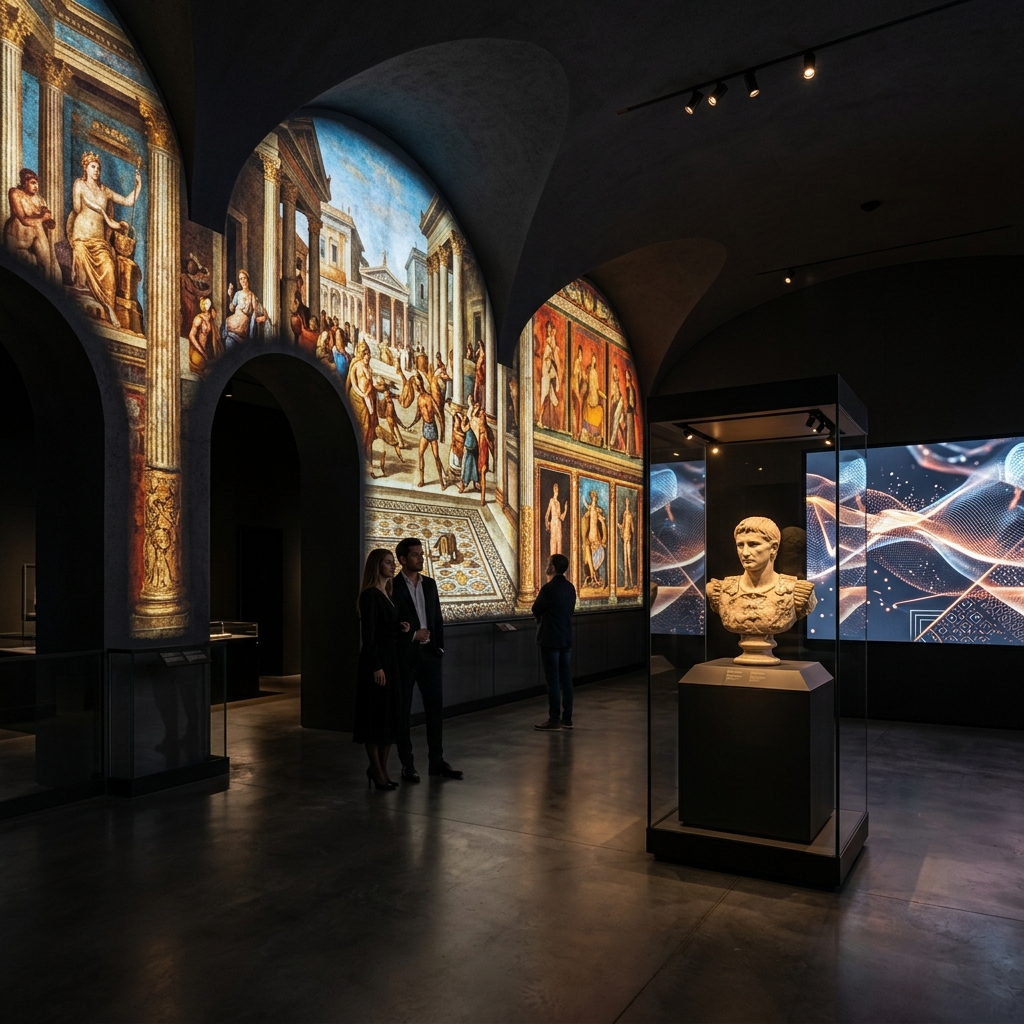
You stand in an empty room. White walls, wooden floor, silence. And then someone hands you goggles and suddenly, you are inside the fresco of a Pompeian house that burned down two thousand years ago. Do you smell the ash? No, they can't do that yet. But you hear the crackle of fire, you see the plaster crack to reveal a mosaic that no tourist will ever see with their own eyes, because the original is too fragile to exhibit.
This is not science fiction. This is the Virtual Archaeological Museum (MAV) in Herculaneum, which has been reconstructing ancient cities with three-dimensional projections and holograms for years. But what is happening in culture in 2025 goes far beyond a hologram in a display case.
The End of the 'Do Not Touch' Era
For centuries, museums have been governed by one rule: look, but don't touch. And that rule makes sense, we're not going to pat Rodin on the head. But the consequence of this empire of sight is that most people leave the museum feeling slightly intimidated, with just a quick snapshot on their phone. But what if they could "step inside" the painting?
The Metropolitan Museum of Art in New York did just that. Their "Dendur Decoded" project allows you, via VR goggles or simply a web browser, to walk around the Temple of Dendur, rotate it, peer into cracks in the stone that you wouldn't see even standing right in front of it. The most interesting part? It's not about a 'cool effect.' It's that people have started spending three times longer at this temple than at the physical exhibit. Because they could touch it, if only digitally.
The Sound You Cannot See
There is something rarely discussed in the context of immersive media that, in my opinion, changes everything: "spatial audio".
Imagine an exhibition about life in a medieval market. You can hang engravings and copperplates on the wall. You can put up a model. Or, you can make it so that when you enter the room, you hear a blacksmith on your left, a merchant selling apples on your right and the sound of a passing cart behind you. Sound is not an illustration. Sound is the architecture of the experience.
Spatial audio, binaural sound, Dolby Atmos objects, ambisonic systems, is ceasing to be the exclusive domain of concerts and video games. MuseumNext reports that more and more institutions are deploying three-dimensional soundscapes as independent narrative elements. Not as a background. As the main axis of the story. And that is beautiful, because sound is the most democratic sense, you don't need goggles, an expensive phone, or even sight to experience it.
When AI Ceases to Be Scary
I know, I know, AI in art stirs controversy. 'A machine doesn't create, a machine copies.' I've heard it a hundred times. And in many contexts, it's true. But there is one area where generative AI does something no human can do: "reconstructing what was destroyed".
Imagine a fresco of which only 30% remains. An art historian can describe what was there, based on sources, analogies, other works of the era. But AI can "see" it. It can analyze thousands of similar frescoes, understand the style, palette, composition and propose a reconstruction that is a hypothesis, not a forgery. It's a research tool, not a replacement for the artist.
At the Cleveland Museum of Art, the "ArtLens" space is undergoing a thorough transformation. For 2026, they are planning an experience where AI not only tailors content to the visitor's interests but responds in real time, changing lighting, sound mood, even the temperature of the narrative. This is not Netflix-style personalization. It's closer to a conversation.
teamLab and the End of the 'White Cube'
You cannot write about immersive media in culture without mentioning teamLab. Their permanent space "teamLab Phenomena" in Abu Dhabi, opened in April 2025, is something hard to put into words, because that's the whole point. The "Massless Suns" and "Levitation Void" installations react to the movement of visitors, changing depending on the weather, time of day and the number of people in the room. No two visits are ever the same.
And this is the key to understanding why immersive media is not a 'trend.' Trends pass. This is a "paradigm shift". A gallery is no longer a white box where paintings hang. A gallery is an organism that breathes.
Venice, The Laboratory of the Future
Venice Immersive 2025 showed us where we are headed. On the island of Lazzaretto Vecchio, a former quarantine site, artists presented works that defy categories. "The Clouds Are Two Thousand Meters Up" is a free-roam VR experience where you move physically through space, while Gaussian splatting technology creates a landscape so detailed that you forget where the room ends and fiction begins. "Blur" combines immersive theater with mixed reality, erasing the line between spectator and performer.
This is no longer cinema. This is no longer theater. This is no longer a gallery. It is something new, for which we are still searching for a name.
What is Not Talked About at Conferences
Every technological revolution has a dark side and it would be dishonest to ignore it.
"Costs." Producing a single museum-grade VR experience often requires a six-figure budget. Small regional museums, which need new ways of attracting audiences the most, have the least money for it. Solutions? Open standards (WebXR, glTF), shared resources, grants, but above all, a shift in thinking about cultural budgets.
"Algorithmic homogenization." If AI reconstructs a destroyed work, whose aesthetics dominate? Researchers from cumincad.org warn of 'AIgemony', the risk that models trained on Western European data will impose their perspective on cultures with completely different visual traditions. UNESCO made it clear at the MONDIACULT 2025 conference: we need ethical frameworks before we go further.
"Digital tourism vs. the real experience." Will a virtual Hagia Sophia replace the real one? I hope not. But I fear that for some people, yes. That's why the best projects don't replace reality. They invite you to it. They say: 'look at what is here, now go and see it with your own eyes.'
What Follows from This
I have been working at the intersection of AI, XR and visual creation for several years and I see one thing clearly: "technology is not the goal. Technology is a bridge." A bridge between the past and the present. Between the exhibit and the human. Between what is visible and what can be felt.
The best immersive projects I've seen, from MAV in Herculaneum to teamLab in Abu Dhabi, share one thing: respect. Respect for the content, for the audience, for the source material. Technology is at their service, never the other way around.
If you run a cultural institution and wonder where to start, start with a question, not with equipment. Not 'what goggles should we buy,' but: "what story do I want to tell and who needs it?" The rest is a matter of a good team, an open mind and a bit of courage.
Because a breathing museum begins with a human who lets it draw breath.
Marta Solik is the founder of Immersive Media Studio, Stereochromatic Solutions. She works at the intersection of artificial intelligence, XR and visual creation. Vice President of Institut EuropIA Poland & CEE.
#immersivemedia #kulturaiai #spatialaudio #virtualreality #augmentedreality #martasolik #muzeaai #spatialcomputing #ai #stereochromatic #poland #warsaw